Falling in Love with America: A Two‐Week Road Trip Across Seven States
This is how my husband and I work: we get an idea, a spark of a destination, a sense of
what we want to see and how many days we have. Everything else is my domain — as long
as I leave him at least one day for fishing. That’s the deal.
Since his job takes him to the West Coast once a year, we decided to turn that opportunity
into a two‐week road trip and see as many national parks as humanly possible. The original
plan was to follow US Route 89, the legendary scenic highway that links seven national
parks. But of course, I can never limit myself to what’s strictly “on the route.” When there’s
something extraordinary just a hundred kilometers away, how could I resist?
Traveling with me is not for the faint‐hearted. My days are planned down to the minute:
when we eat breakfast, how long we have for breakfast, how long we drive, how much time
we have for sightseeing, where we sleep, whether the price matches the quality… Luckily,
my husband is essentially the male version of me. We’re perfectly matched — not only in
travel, but in life. On longer trips, the first few days are meticulously planned; the rest we
leave with a bit of breathing room. You never know what surprises the road might bring.
Our journey became a zig‐zag odyssey through seven states — Colorado, Wyoming, Idaho,
Utah, Arizona, Nevada, and California. In two weeks, we covered roughly 5,400 kilometers.
We visited six national parks, two state parks, several big cities, and countless small towns
that win you over with their warmth. And in every new place I said, without fail: “I could live here.”
Denver to Cody: Entering the West
We landed in Denver late at night, so staying near the airport was the obvious choice. We
rented a car through Booking — Genius Level 3 perks meant we got a Nissan SUV for 14
days for 599 dollars. If you plan to visit off‐road gems like Moonscape Overlook or drive the
full Valley of the Gods route, trust me: get an SUV with four‐wheel drive.
The next morning, a seven‐and‐a‐half‐hour drive awaited us — destination: Cody,
Wyoming. When we have to drive long distances (and let’s be honest, America is
enormous), we try not to exceed nine hours in a single day.
Cody is a town of about ten thousand people, an hour from Yellowstone’s east entrance.
Founded by Buffalo Bill in 1896, it still proudly hosts the “Irma” hotel he opened himself. It’s
known as the rodeo capital of the world, and I was excited to finally see real cowboys in
their natural habitat. We had Yellowstone playing on repeat before the trip. Unfortunately,
wrong season — rodeos run from June to August. Still, the town radiates that perfect
Western charm, and it’s where I bought my first pair of cowboy boots.
Accommodation here is far more affordable than inside the national park. Three‐star hotels
run around 200–250 dollars, while inside the park the price doubles. Roadside motels are
even cheaper if you’re flexible.
Since non‐residents now pay an additional 100 dollars on top of the 20–35 dollar entrance
fee for the most visited national parks — Yellowstone, Yosemite, Zion, Grand Canyon — my
advice is simple: buy the annual pass for 250 dollars. It covers four people and grants
access to all national parks that charge entry. The National Park Service app is also
incredibly useful for planning, maps, and weather updates.
Yellowstone & Grand Teton: Nature in Its Purest Form
Yellowstone is the world’s first national park, established in 1872. It spans nearly 9,000
square kilometers, boasts around 500 active geysers, 160 kilometers of hiking trails, 67
species of mammals, and experiences about 3,000 earthquakes a year. It sits atop a
supervolcano that has erupted three times so far, roughly 725,000 years apart — meaning
we theoretically have about 100,000 years left. But who can say for sure? As we entered the
park, my first thought was: “Please, not today. Just give us these two days.”
The park is divided into two loops: the upper loop (113 km) and the lower loop (155 km).
With only one full day, we focused on the major highlights. Most require only short, easy
walks; some can be admired straight from the car.
Hayden Valley is the perfect place to spot wildlife — bison, bears, wolves. You cannot
imagine how majestic these animals are until you see them up close. Warning signs are
everywhere, explaining what to do if you encounter them. I bought bear spray, though the
shopkeeper told me it wouldn’t help much if we actually met one.
On the western side of the upper loop lies Mammoth Hot Springs, a surreal terrace of
thermal springs cascading down a hillside. Their white color comes from calcium
carbonate deposits, and the formations shift constantly.
Driving through the park, you encounter countless geothermal wonders. The one you
absolutely cannot miss is Grand Prismatic Spring — the largest hot spring in the United
States, 50 meters deep, with water at 70°C. It’s Yellowstone’s signature image: a
breathtaking palette of orange, red, turquoise, and green. The colors come from heat‐loving
bacteria, and the shades shift with the seasons.
We saved Old Faithful for last, hoping the crowds would thin out — and our lodge was just
minutes away. If we missed it, we could always return early in the morning. The National
Park Service website lists predicted eruption times, giving us enough time to settle into the
Old Faithful Snow Lodge and find a spot on a bench for the show. The geyser erupts roughly
every 102 minutes ±10, lasting from 90 seconds to five minutes, reaching about 40 meters
in height and temperatures of 95.6°C.
One crucial tip: never leave food unattended. Not just because of bears — the ravens are
master thieves. They can unzip pockets and steal items with surgical precision.
Just fifteen minutes from Yellowstone’s south entrance lies another gem: Grand Teton
National Park, named after the 4,197‐meter Grand Teton peak. Here you can hike (320 km
of trails), fish, watch wildlife, cycle… We stopped to admire pronghorn antelopes and
visited the remains of the Mormon community founded in the 1890s, known as Mormon
Row.
Jackson Hole, Idaho & Bonneville: Luxury, Charm, and Salt
Jackson Hole is one of those places you simply cannot skip when traveling through this part
of America. I would describe it as a luxurious ski town wrapped in a perfect Western
atmosphere — a place where wealthy visitors stroll out of upscale restaurants wearing
cowboy boots and custom‐made hats that cost more than my entire suitcase.
We originally planned to stay in Jackson Hole, but the prices — around 300 dollars per
night, and often far more — quickly sobered us. So we chose the Teton Teepe Lodge, about
an hour’s drive away, which required crossing briefly into Idaho. Another one of my zig‐zag
detours. And it was worth every minute and every mile.
The lodge is built like a giant wooden teepee, inspired by Native American dwellings.
Eighteen rooms arranged in a circle around a central gathering space with a massive
fireplace. A self‐service bar, a billiard and poker table upstairs, and outside — a fire pit and
loungers by a small creek. By the end of the evening, you know every guest by name as you
roast marshmallows together. After a generous breakfast of homemade muffins, banana
bread, eggs, and everything your heart desires, we set off on a four‐hour drive to Salt Lake
City. Not to explore the city — just to break up the journey toward Capitol Reef.
We checked into a hotel near the airport, and then my husband did something that
perfectly explains why every woman deserves her own Wayne — and why my daughter says
we’ve set the bar impossibly high. I casually mentioned that the Bonneville Salt Flats were
about an hour and a half away — one of the world’s most iconic speed‐testing grounds. My
simple wish to see them was enough for him to say: Let’s go.
An hour and a half of driving for fifteen minutes of walking on the salt flats — and then an
hour and a half back. If that’s not love, I don’t know what is.
Bonneville is the ancient dry bed of a prehistoric lake, formed at the end of the last Ice Age.
It’s the largest of several salt flats near the Great Salt Lake. The last land‐speed record here
was set in 1970 by Gary Gabelich’s rocket car, Blue Flame — 631.4 mph (1016 km/h). The
endless white horizon, the blue sky above, the crunch of salt under your feet, the taste of
minerals in the air — it’s a photographer’s dream.
Next on our list was Capitol Reef National Park, in the state of Utah — home to the famous
“Mighty Five”: Zion, Bryce Canyon, Capitol Reef, Arches, and Canyonlands. This state is our
kind of place: 300 sunny days a year, vast open spaces, friendly and welcoming people
(most of them Mormons), the Colorado River (a guaranteed fishing day), and geological
formations that look like they belong on another planet. Three years ago, we visited Zion
and Bryce Canyon. This time, we wanted to see the remaining three.
Capitol Reef & Skyview
I hadn’t planned much for Capitol Reef. It simply didn’t seem as exciting as the others. How
wrong I was. This park is a hidden treasure — cliffs, canyons, natural bridges in shades of
red, brown, and gold. It’s famous for the Waterpocket Fold, the largest exposed monocline
in North America — a 161‐kilometer wrinkle in the Earth’s crust formed 65–80 million years
ago. Erosion then sculpted it into the dramatic landscape we see today.
Weather is crucial here. Flash floods can appear out of nowhere, and warning signs follow
you throughout the park. We arrived in the afternoon and missed the famous fresh fruit pies
at the historic Gifford Homestead — they sell out early, so sweet‐toothed travelers, take
note.
Unlike many European national parks, American parks allow you to drive right up to the
attractions. Parking lots sit at the base of the landmarks, and only short walks are needed
— though there are trails for serious hikers too. We managed a brief canyon walk before
darkness fell, and I was secretly thrilled — Capitol Reef is known for its stargazing. Vast
desert, no light pollution, and a sky so clear it feels like you’re floating in space.
I had chosen a special place to stay: the Skyview Hotel in Torrey. They also offer glamping,
but the tents were fully booked. Still, the rooms — and the entire hotel — are works of art.
The owners are artists who display their creations throughout the property, and the
architecture itself is a tribute to the surrounding landscape. There’s no restaurant;
breakfast must be ordered a day in advance and delivered from a nearby café. But the room
is stocked with local treats, juices, and snacks.
The real magic happens on the terrace after dark. Lounge chairs, blankets, and the Milky
Way stretching above you. That moment — sitting with the person you love, trying to
identify constellations and managing only the Big and Little Dipper — that’s the kind of
moment that makes life beautiful. The hotel even gives you a barcode you can scan to
guide you through the night sky.
Unfortunately, the magic ended abruptly — I woke myself up snoring. Yes, my own snoring.
Moonscape Overlook: Another Planet on Earth
Not far from the town of Hanksville lies a hidden place not marked on any map — the
absolute highlight of our entire trip: Moonscape Overlook. When people ask me which
place enchanted me the most, this is the one.
To get there, you need a high‐clearance 4WD vehicle. You drive about 15 kilometers on an
unpaved road, and it’s strongly advised not to attempt it after rain — even four‐wheel drive
can get stuck in the mud. Wayne had no idea where he was going; he kept asking if I was
sure. After thirty minutes of bouncing over rough terrain, even I began to doubt. We passed
one car. I wondered if we had missed the turn, but the directions insisted we were close.
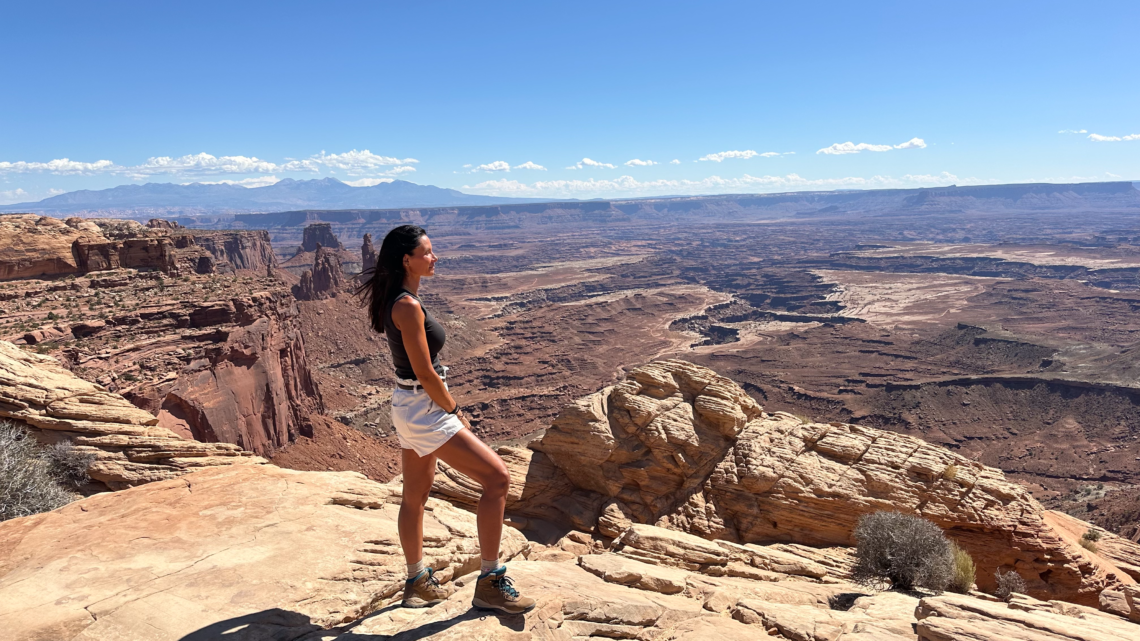
We parked on a widened patch of road, walked toward the edge — and stepped into
another world. Before you stretches a landscape that looks like the Moon, Mars, or some
distant planet. A barren, cracked, gray expanse sculpted by 90 million years of erosion. No
fences, no signs, no paths — just wind and silence. It exceeded every expectation I had.
Nearby is the Mars Desert Research Station, a simulation facility where scientists train for
life on another planet. I hoped we could visit, maybe see a museum, but it’s closed to the
public. You can stop briefly in the parking lot — that’s it.
Goblin Valley: A Playground of Stone Creatures
Not far from Moonscape Overlook lies a cluster of natural wonders that feel almost unreal
— a pocket of Utah where the landscape seems to have been sculpted by a mischievous
artist with a wild imagination.
Goblin Valley State Park sits in the San Rafael Desert, a place where thousands of
mushroom‐shaped rock formations — “goblins” — stand frozen in time. These whimsical
shapes were carved over millions of years: soft sandstone below, capped by harder rock
above, slowly eroded by wind and water. The result is a valley that looks like a gathering of
stone creatures, each with its own personality.
Walking among them, you lose all sense of scale and time. Every formation resembles
something — a creature, a face, a statue — and the valley feels like the world’s most
surreal playground. There are no fences, no barriers, just a few signs reminding you to
respect the fragile geology. In summer, temperatures soar to 38°C, so water is essential.
Goblin Valley, Moonscape Overlook, and the Mars Desert Research Station — three
extraordinary places — all fit into a single day. A day that felt like traveling across three
different planets.
Moab, Arches & Canyonlands: The Heart of Red Rock Country
Moab is the perfect base for exploring Arches and Canyonlands National Parks. Both are
about a 30‐minute drive away, and the town itself is vibrant, colorful, and full of life. It’s an
outdoor paradise: off‐roading, mountain biking, rafting on the Colorado River, rock
climbing, stargazing, hiking… and for those who prefer quieter joys, there’s fishing,
photography, and endless scenic drives.
We stayed at the Fairfield Inn & Suites by Marriott Moab, just eight minutes from the Arches
entrance. In summer, three‐star hotels run around 200 dollars per night, though motels and
private rentals can be cheaper.
Before visiting Arches, it’s crucial to check whether you need a timed entry reservation — a
system used during spring and late summer. Without a reservation, you can enter before 7
a.m. or after 4 p.m. If you can’t get a slot, simply visit Canyonlands first (no reservation
needed) and head to Arches later in the afternoon. Yes, you can see both parks in one day if
you focus on the highlights — though each deserves far more time.
Both parks sit on the Colorado Plateau, a vast region of red rock and layered sandstone
shaped by water, wind, and ice over millions of years.
Arches National Park: A Cathedral of Stone
Arches is the world capital of natural stone arches — around 2,000 of them. They form and
collapse constantly; the landscape is alive, shifting, evolving.
The most famous is Delicate Arch, a 16‐meter freestanding giant and the symbol of Utah.
Reaching it requires good shoes, a hat, plenty of water, and ideally a hiking pole. The trail is
about 5 km round‐trip, steep in places, with no shade. It’s the kind of hike that reveals who
leads an active life — and who is here only for the Instagram photo.
But when you reach the top and Delicate Arch rises before you, isolated and monumental,
you understand why people wait in line to take a photo beneath it. It’s not the tallest arch in
the park, but its setting makes it feel like a gateway to another world.
Another iconic formation is Balanced Rock, a 3,577‐ton boulder perched improbably on a
narrow pedestal, defying gravity.
The tallest arch is Double Arch, with a vertical opening of 34 meters, while the longest in
North America is Landscape Arch, stretching an astonishing 93.3 meters — only 1.8 meters
thick at its narrowest point. Many arches can be admired from the car or via short walks.
Wayne’s verdict: “See one arch, you’ve seen them all.”
He’s wrong, of course — but I let him have his moment.
Canyonlands: Where Rivers Carve a World of Stone
Canyonlands is the largest national park in Utah, divided by the Colorado and Green Rivers
into four distinct districts, each so isolated that traveling between them can take hours.
For panoramic views of the canyons carved by the rivers, you head to Island in the Sky. The
most famous feature here is Mesa Arch, perched on the edge of a cliff like a window into
infinity. It was the only place we had time to visit — and even that brief stop was
unforgettable.
The other districts each have their own character:
- The Needles, named for its towering rock spires
- The Rivers, beloved by kayakers
- The Maze, the most remote and challenging area, practically untouched
Canyonlands is also a certified International Dark Sky Park with “Gold‐Tier” status —
meaning some of the clearest night skies on Earth.
Potash Road: A Scenic Drive for the Soul
North of Moab lies one of the most scenic roads in the United States — Potash Road, a
24‐kilometer stretch (the paved portion) that winds between towering cliffs on one side and
the Colorado River on the other. The most famous section is Wall Street, a world‐renowned
climbing destination. Nearby, ancient Native American petroglyphs — up to a thousand
years old — decorate the rock walls.
This is where I imagine myself in a Ford Mustang or a Cadillac Eldorado Biarritz, scarf
fluttering in the wind, hair dancing in the breeze. My husband, naturally, would be
somewhere nearby — fishing.
Leaving Moab behind, the landscape slowly shifted from red rock cathedrals to wide, open
desert — the kind of emptiness that feels almost sacred. And then, as if the earth wanted
to surprise us again, a small brown sign appeared: Historic Site.
One look between us — that silent “I know you / you know me” moment — and we turned
off the main road.
Bluff Fort: A Testament to Human Endurance
Bluff Fort is a living monument to one of the most difficult pioneer expeditions in the history
of the American West. In 1879–1880, a group of Mormon settlers set out on what was
supposed to be a six‐week, 400‐kilometer journey. It took six months. They carved a
passage for their wagons through a vertical cliff above the Colorado River — a place now
known as Hole‐in‐the‐Rock.
At Bluff Fort, you can search their genealogical records if you know your ancestor’s full
name and year of death. And then — a miracle of coincidence — Wayne found his own
ancestors among these extraordinary pioneers. Sometimes the most unplanned stops give
you the most unforgettable moments.
Valley of the Gods: A Desert of Stone Guardians
From Bluff, the road leads into Valley of the Gods, a 27‐kilometer unpaved track winding
through a desert dotted with towering red rock formations. For the Navajo people, these
isolated monoliths are sacred — ancient warriors turned to stone, guarding the land.
They call it the “Little Monument Valley,” but unlike its famous sibling, this valley is free to
enter and open for camping. If you don’t have a 4WD vehicle, admire it from the main road
— the terrain can be rough, and the sand deep.
We chose solitude over crowds, adventure over comfort. A little bit young and a little bit
foolish — the best combination. Every time we thought we finally had a moment alone, a
camper or car would appear out of nowhere and stop to ask for directions. On the only
road. In the entire valley.
Forrest Gump Point: The Road That Became a Legend
About 40 kilometers after leaving the valley, the landscape suddenly aligned into a perfect
cinematic frame — the long, straight road leading directly toward the monumental buttes
of Monument Valley.
Forrest Gump Point.
Even if you’ve never seen the movie, you stop. Everyone stops. People run into the middle
of the road, arms spread, shouting, “I’m pretty tired… I think I’ll go home now.”
And for a moment, you understand why this place became iconic. The road, the silence,
the red giants in the distance — America’s nature is unlike anything else. It’s impossible not
to fall in love with it.
Page, Arizona: A Town Born Overnight
Crossing into Arizona, we arrived in Page, a town that quite literally sprang up overnight.
Founded in 1957 to house workers building the Glen Canyon Dam, it sits on land
exchanged with the Navajo Nation. Because of that, Page has a unique quirk:
Arizona does not observe daylight saving time — but the Navajo Nation does.
If you’re booking tours to Antelope Canyon, this one‐hour difference can cause chaos.
We visited Antelope Canyon three years ago — a sacred place that deserves its own story.
This was Wayne’s moment — a full day dedicated to fishing.
Two hours of driving to reach the perfect spot on the Colorado River, another hour climbing
through brush and rocks, and four hours of casting his line… catching absolutely nothing.
But the beauty was in the silence, the river’s murmur, the peace. He came back glowing.
He was happy. I was happy.
And the next day was my turn — shopping at the Las Vegas outlet.
We’ve been to Vegas before. For us, it’s one of those places you only need to see once.
Though, to be fair, we did buy our wedding rings there, almost got married (another story
entirely), and realized that our son Mika must be brought here when he turns 21 — the boy
can count cards, and poker might just be his hidden superpower.
Death Valley: Beauty at the Edge of Survival
The drive from Page, through Las Vegas, to Death Valley National Park took nine hours
without stopping. We had tried to visit Death Valley the previous year, but heavy rains had
closed most of the park.
And now — déjà vu.
The valley had just experienced the wettest autumn in recorded history.
Once again, parts of the park were closed, including the famous Badwater Basin.
But this time, nothing could stop us. If we waited for perfect conditions, Death Valley might
turn into Sea Valley at the rate things were going.
We chose to stay at The Inn at Death Valley, a historic luxury resort built in 1927. Hollywood
legends like Marlon Brando, John Wayne, and Ernest Hemingway once stayed here.
Surrounded by lush gardens fed by natural springs, the resort is a stunning contrast to the
barren desert around it.
The outdoor pool is filled with spring water at a constant 31°C. The rooms — whether in the
main building or the private casitas — blend rustic charm with understated luxury. At first, I
thought it was an unnecessary splurge. But after a full day in the desert’s furnace, it was
worth every cent.
Even with closures, you can see the highlights in one day:
- Badwater Basin — the lowest point in North America at 86 meters below sea level. A
vast crust of white salt stretching to infinity. (Closed due to flooding during our visit.) - Artist’s Palette — hills painted in shades of green, yellow, pink, and orange, created
by oxidized minerals. Most beautiful at sunset. - Mesquite Flat Sand Dunes — where parts of Star Wars were filmed. This is where
Wayne picked me a “flower.” More like a branch. But it’s the thought that counts. - Racetrack Playa — the mysterious “sailing stones” that move across the dry
lakebed, leaving long tracks behind them. Scientists recently discovered that a rare
combination of thin ice and light wind pushes them along.
Death Valley is the quietest national park we’ve ever visited. The silence feels ancient,
almost intimidating — as if the desert could swallow you whole if you stayed too long.
And then you return to the resort, order a cocktail, and slip into the warm pool — restoring
the balance of existence.
After the raw silence of Death Valley, the road carried us toward the ocean — toward San
Diego, a city we already knew well, a place that feels like a soft landing after the wildness of
the desert. Six hours of driving, and suddenly the world changed: palm trees, sea breeze,
the gentle hum of California life.
For me, San Diego meant five days of rest — pool, gym, sunshine.
For Wayne, it meant five days of work… so that we could plan our next adventure.
That’s our rhythm. That’s our partnership.
And it works.
San Diego is classic California dreaming — beaches, surfers, sunsets, and a lifestyle that
feels effortlessly joyful. It deserves its own story, and one day I’ll give it the space it
deserves.
“The Road That Stays With You”
Most of this journey took us through forgotten expanses — places where the world feels
untouched, where the horizon stretches endlessly, where you can drive for fifty kilometers
without seeing another soul. There’s something hypnotic about that rhythm: the hum of the
engine, the shimmer of asphalt in the heat, the realization that you might be the only living
being in a vast circle of desert and sky.
No signal.
No noise.
Just you, the road, and the land.
Time stops mattering.
Only freedom remains.
And that — that is where you fall in love with America.